

 Portable Chiller
 Air-Cooled Chiller
 Water-cooled Chiller
 Low-temperature Chiller
 Custom Industrial Chiller


In beverage manufacturing, temperature control directly affects product quality, flavor consistency, carbonation stability, microbial safety, and production efficiency. Whether producing bottled water, carbonated soft drinks, fruit juice, dairy beverages, energy drinks, or alcohol-free functional beverages, maintaining stable process temperatures is essential throughout the entire production cycle—basically, if the temperature’s off, the whole batch could be compromised.
Unlike standard industrial cooling applications, beverage production requires cooling systems that combine:
- Stable temperature control (±0.5°C or better in most cases)
- Food-grade hygienic design that meets regulatory standards
- Continuous 24/7 operation capability
- Energy-efficient performance to keep operating costs down
- Reliable process integration with existing production lines
In modern beverage plants, industrial chillers aren’t just auxiliary cooling devices sitting in the corner—they’re an integrated part of the production process itself.
Why Cooling Is Critical in Beverage Manufacturing
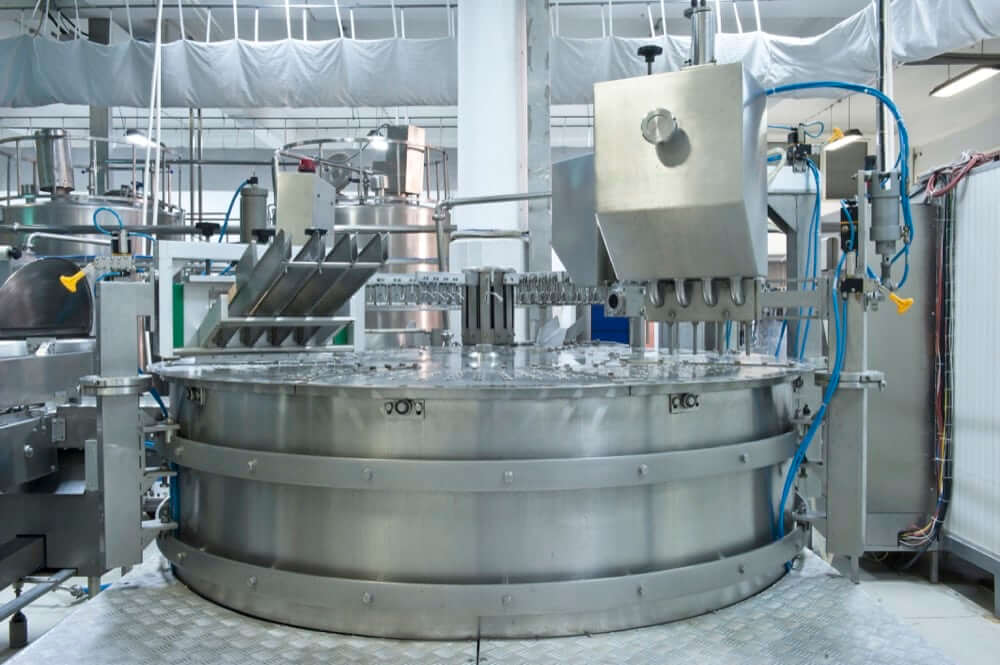
Heat gets introduced into beverage production at multiple stages, including ingredient mixing, pasteurization, fermentation, carbonation, filling, and CIP cleaning systems. Each stage has its own thermal personality, so to speak, and unstable cooling can directly mess with product consistency and safety.
Common Temperature-Related Issues
Here’s where things get tricky. If cooling isn’t spot-on:
- Carbonation systems: Warmer liquid reduces CO₂ solubility—meaning flat drinks and inconsistent carbonation levels that customers definitely won’t love
- Dairy beverages: Excessive temperature may accelerate protein degradation, causing that unpleasant “gone bad” taste before the expiration date
- Juice processing: Unstable cooling may increase oxidation and flavor loss—basically the fresh taste goes away faster than it should
- Pasteurization: Insufficient post-cooling can increase microbial risk, which is a safety issue nobody wants to deal with
Process temperature stability: ±0.5°C
Some fermentation or carbonation applications may require tighter control, down to ±0.2°C.
Main Cooling Processes in Beverage Production
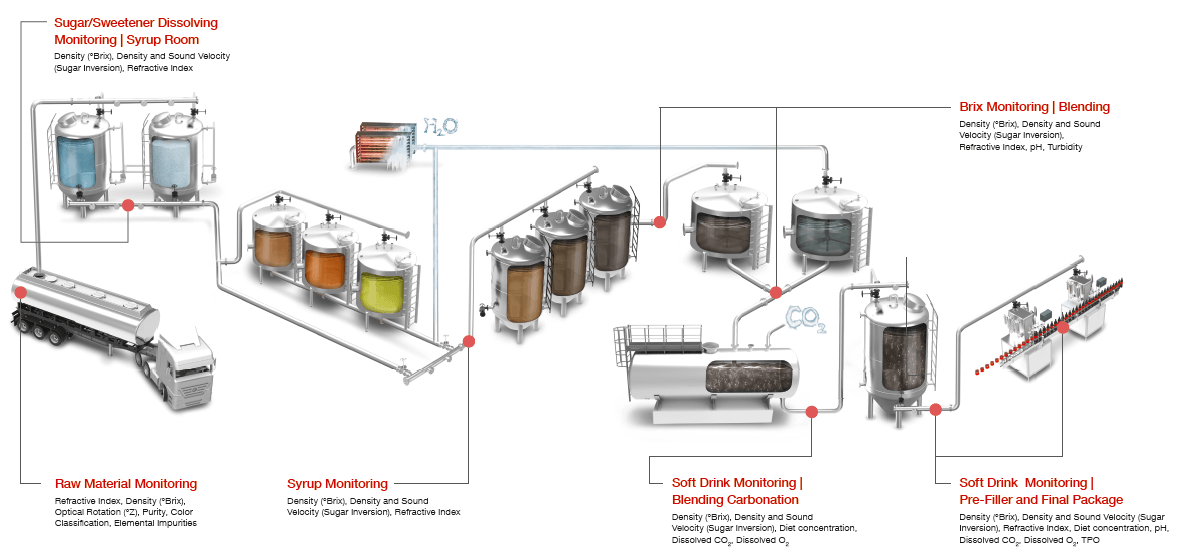
Beverage manufacturing typically involves several independent but interconnected cooling stages, kind of like a well-choreographed dance where each dancer needs to hit their mark.
Process Cooling Overview
| Production Stage | Main Thermal Requirement | Cooling Objective |
|---|---|---|
| Ingredient Mixing | Temperature stabilization | Maintain formulation consistency |
| Pasteurization Cooling | Rapid heat removal | Prevent microbial growth |
| Fermentation | Continuous heat removal | Stabilize yeast activity |
| Carbonation | Precise low-temperature control | Improve CO₂ solubility |
| Filling Line | Equipment temperature stability | Maintain production continuity |
| CIP System | Thermal cycling support | Cleaning efficiency |
Each stage behaves differently thermally, which is why beverage cooling systems are usually designed as multi-zone thermal management systems rather than one-size-fits-all single-point cooling solutions.
Cooling After Pasteurization
One of the most critical cooling stages happens right after pasteurization or thermal treatment. This is where you need to act fast—think of it like cooling down after a workout.
After heating, the beverage must be cooled rapidly to:
- Prevent any lingering microbial activity
- Protect those delicate flavor compounds
- Reduce oxidation that can ruin the taste
- Get it ready for downstream processing
If cooling is too slow, you’re looking at problems like reduced shelf stability, compromised product taste, loss of nutritional properties, and process hygiene issues. Nobody wants that.
Plate heat exchangers combined with industrial chillers are the go-to solution here because they deliver fast heat transfer, compact structure, stable outlet temperatures, and hygienic operation—all the boxes you need to check.
Fermentation Cooling Systems
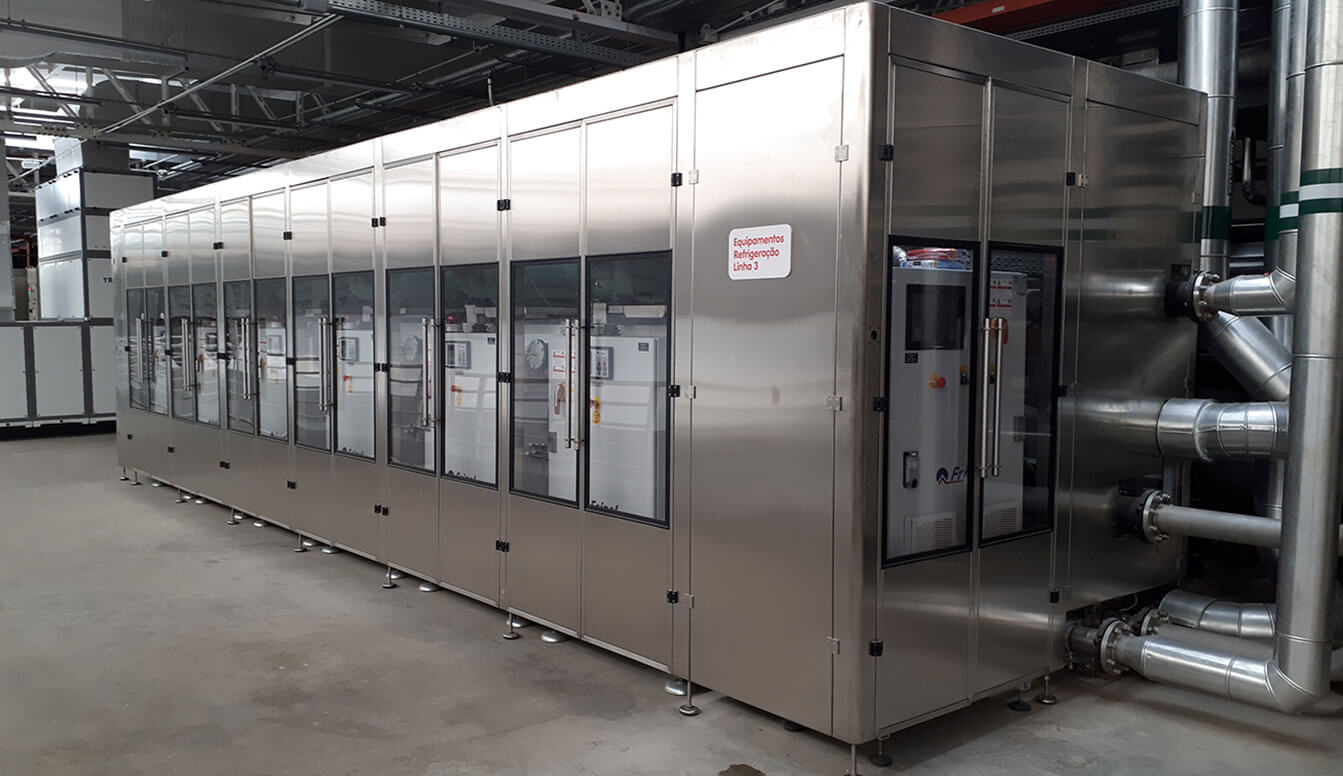
Fermentation generates continuous metabolic heat as yeast converts sugars into alcohol or other byproducts. This is an exothermic process, so without proper cooling, things can get out of hand pretty quickly.
Without proper cooling:
- Fermentation temperature starts climbing
- Yeast activity becomes erratic and unpredictable
- Off-flavors may develop—definitely not the taste you were going for
- Product consistency goes out the window
Typical Fermentation Temperature Requirements
| Beverage Type | Typical Fermentation Temperature | Stability Required |
|---|---|---|
| Beer (ales) | 18–22°C | ±0.5°C |
| Beer (lagers) | 8–12°C | ±0.3°C |
| Kombucha | 22–30°C | ±1.0°C |
| Functional Fermented Drinks | 20–28°C | ±0.5°C |
| Dairy Fermentation (yogurt) | 35–45°C | ±0.5°C |
Typical metabolic heat: 70–120 W per 10⁹ cells/L
A 100 HL fermentation tank can generate 50–100 kW of heat during peak fermentation activity.
Industrial chillers maintain stable fermentation conditions by circulating chilled glycol or water through jacketed tanks, plate heat exchangers, and external cooling loops. In fermentation applications, temperature stability is often more important than maximum cooling capacity—you want steady, not necessarily super-cold.
Carbonation and CO₂ Solubility Control
Carbonation systems are super temperature-sensitive because gas solubility changes directly with temperature. This is governed by Henry’s Law, and it matters a lot for getting that perfect fizz.
C = kH × P
Where: C = dissolved gas concentration, kH = Henry’s constant, P = partial pressureCO₂ solubility decreases approximately 3–4% per 1°C increase in liquid temperature.
As liquid temperature increases:
- CO₂ dissolves less efficiently—you’re basically fighting physics
- Carbonation consistency decreases across batches
- Foam generation increases during filling, causing waste and headaches
The relationship between temperature and gas solubility is particularly important in soft drink production, sparkling beverages, and functional carbonated drinks. Keeping the beverage at lower temperatures throughout carbonation improves efficiency and reduces CO₂ consumption—good for quality and good for the bottom line.
How Industrial Chillers Work in Beverage Plants
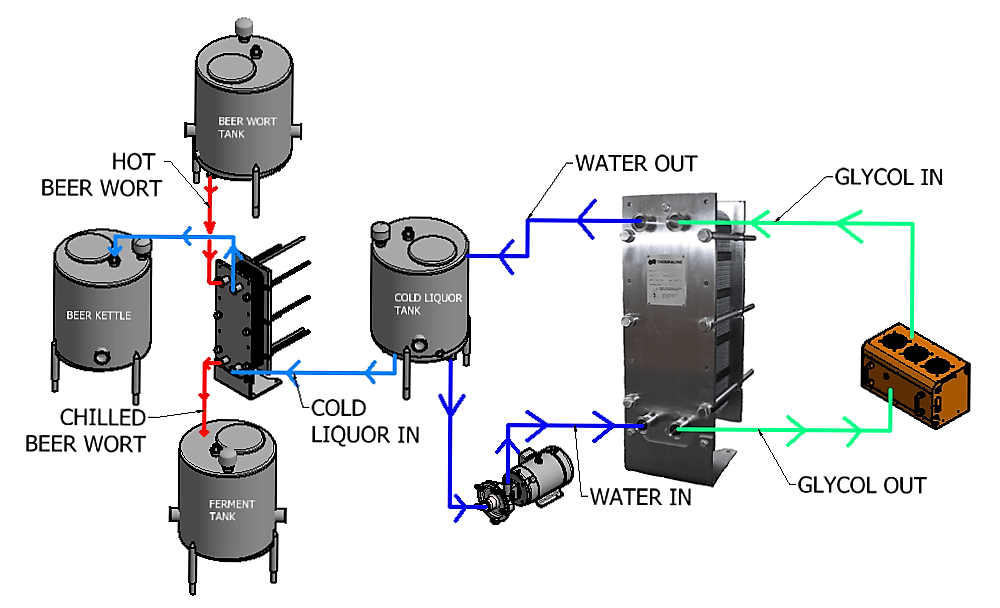
Industrial chillers remove heat through a closed-loop refrigeration system. The basic idea is pretty straightforward: absorb heat from the process, reject it somewhere else, repeat.
The system typically includes:
- Compressor: The heart of the system that drives the refrigeration cycle
- Condenser: Where heat is rejected to the environment (air or water)
- Expansion valve: Controls refrigerant flow into the evaporator
- Evaporator: Absorbs heat from chilled water or glycol solution
- Circulation pump: Delivers temperature-controlled fluid to production equipment
- Intelligent control system: Keeps everything running smoothly and precisely
Common Cooling Mediums in Beverage Production
Cooling Fluid Comparison
| Cooling Medium | Temperature Range | Advantages | Typical Application |
|---|---|---|---|
| Chilled Water | 5–15°C | High heat transfer efficiency, low cost | General beverage cooling |
| Water-Glycol Mixture (20%) | -5 to 10°C | Freeze protection, stable viscosity | Low-temperature fermentation |
| Food-Grade Glycol (30–40%) | -15 to 5°C | Safe for food environments, anti-freeze | Beverage process cooling |
| Secondary Brine Systems | -20 to 0°C | Very stable low temperatures | Specialized cryogenic applications |
Glycol-based systems are widely used in beverage plants because they prevent freezing (essential for outdoor tanks in winter), improve low-temperature stability, support long piping systems without flow issues, and reduce seasonal operating risks. Essentially, they give you peace of mind year-round.
Water-Cooled vs Air-Cooled Beverage Chillers
Industrial chillers used in beverage plants generally come in two flavors: water-cooled and air-cooled. Each has its place depending on your setup.
Comparison Table
| Item | Water-Cooled Chiller | Air-Cooled Chiller |
|---|---|---|
| Energy Efficiency (COP) | 4.0–6.0 (higher) | 3.0–4.5 (moderate) |
| Temperature Stability | Excellent (±0.1–0.3°C) | Good (±0.3–0.5°C) |
| Installation Complexity | Higher (needs cooling tower) | Lower (plug and play) |
| Ambient Temperature Sensitivity | Low (2–3% per 10°C) | High (5–8% per 10°C) |
| Long-Term Operating Cost | Lower | Higher in hot conditions |
| Best Application | Large continuous production | Small & medium facilities |
Water-Cooled Chillers in Large Beverage Factories
Large bottling plants and centralized beverage production facilities typically prefer water-cooled chillers because they offer better thermal stability, lower condensing temperatures, higher operational efficiency, and improved 24/7 reliability.
Water has significantly higher thermal conductivity (~0.6 W/m·K) and heat capacity (~4.18 kJ/kg·K) compared to air, allowing faster heat rejection, lower compressor discharge pressure, and more stable operation under fluctuating loads. Think of it as the difference between cooling down in a pool versus in hot air.
Water-cooled systems are especially suitable for:
- Fermentation facilities with continuous heat generation
- Multi-line bottling plants running around the clock
- Large carbonation systems requiring precise control
- Continuous pasteurization lines
Air-Cooled Chillers for Flexible Beverage Production
Air-cooled chillers are the workhorses of smaller operations. They’re commonly found in:
- Small beverage factories with moderate cooling needs
- Pilot production lines for new product development
- Craft beverage production (breweries, cideries, etc.)
- Decentralized cooling applications
Advantages include easier installation, lower infrastructure cost, simplified maintenance, and no cooling tower requirement. Basically, less complexity and faster setup.
However, performance does depend on ambient temperature. In hot climates:
- Condensing temperature increases
- Compressor has to work harder
- Energy efficiency drops
- Cooling stability may suffer
For this reason, air-cooled systems are generally recommended for moderate cooling loads or facilities with flexible production schedules—places where you don’t need that relentless, consistent performance no matter what the weather’s doing outside.
Hygienic Design Requirements in Beverage Cooling Systems
Food and beverage applications require stricter hygienic standards than general industrial cooling. This isn’t optional—it’s regulated and for good reason.
Common Hygienic Design Features
| Feature | Specification | Purpose |
|---|---|---|
| Stainless Steel 316L | For product-contact surfaces | Prevent corrosion & contamination |
| Closed Loop Design | No exposure to environment | Protect coolant cleanliness |
| Food-Grade Glycol | FDA-compliant formulations | Safe operation near product lines |
| CIP-Compatible Piping | Sanitary fittings, no dead legs | Simplify cleaning procedures |
| Smooth Internal Surfaces | Ra < 0.8 μm (sanitary standard) | Reduce bacterial growth risk |
These design factors help maintain food safety, meet regulatory requirements, and keep production reliable. Skimping on hygienic design is a gamble that rarely pays off.
Precision Temperature Control in Beverage Manufacturing
Modern beverage production often requires stable thermal control across multiple process zones simultaneously—kind of like conducting an orchestra where each section needs to play at exactly the right moment.
Different systems may need low-temperature fermentation cooling, moderate carbonation cooling, rapid post-pasteurization cooling, and stable filling line operation all at the same time.
To achieve stable control under dynamic load conditions, modern chillers commonly use:
- Inverter compressors: Adjust capacity smoothly instead of cycling on and off
- Electronic expansion valves: Precise refrigerant metering for consistent performance
- Variable-frequency pumps: Match flow to actual demand
- Multi-zone PID control systems: Independent temperature control for each production zone
These technologies help minimize temperature overshoot, thermal oscillation, energy waste, and product inconsistency—the four horsemen of beverage quality problems.
Energy Efficiency in Beverage Cooling Systems
Cooling systems are often among the largest energy consumers in beverage factories, sometimes accounting for 20–40% of total facility energy use. Getting this right matters—a lot.
Energy Optimization Technologies
| Technology | Typical Energy Savings | Main Benefit |
|---|---|---|
| Inverter Compressors | 20–35% at part-load | Reduced partial-load power consumption |
| Smart Pump Control | 30–50% pump energy | Improved hydraulic efficiency |
| Heat Recovery | 10–30% of heating costs | Reuse waste heat for facility heating |
| Adaptive Control Logic | 5–15% overall | Better load response and stability |
| High-Efficiency Heat Exchangers | 5–10% | Lower energy loss, faster heat transfer |
In large beverage facilities operating continuously, energy optimization can significantly reduce operational costs—often paying for system upgrades within 2–3 years.
Centralized Cooling Systems in Beverage Plants
Most modern beverage factories use centralized cooling architecture. Think of it as having one powerful chiller plant that serves the whole facility rather than scattered smaller units everywhere.
A central chiller plant supplies chilled fluid to fermentation tanks, carbonation systems, filling lines, pasteurization systems, and packaging equipment—all from one efficient hub.
Advantages of centralized cooling include better energy efficiency through scale, easier maintenance since everything’s in one place, flexible capacity expansion when you need to grow, and improved process coordination across production zones. Different production zones can also operate at different temperature setpoints simultaneously through independent control loops—no conflicts, no compromises.
Conclusion
Industrial chillers are a critical part of beverage manufacturing—they directly influence product quality, flavor consistency, microbial safety, and production efficiency. Getting the cooling right isn’t optional; it’s fundamental to running a successful beverage operation.
Water-cooled chillers provide superior efficiency and thermal stability for large continuous-production beverage plants—think major bottling facilities running 24/7. Air-cooled systems offer simpler installation and flexible operation for smaller facilities and decentralized production lines—craft breweries, regional dairies, that sort of setup.
More importantly, beverage cooling isn’t just about removing heat. It’s a precision process control function that maintains stable thermal conditions throughout every stage of production, from mixing ingredients to filling bottles to cleaning the tanks afterward.
As beverage manufacturing continues moving toward higher automation, stricter quality standards, and greater energy efficiency, industrial chillers will remain an essential part of reliable and consistent beverage production systems. The tech keeps getting better, and the demand for quality keeps growing—it’s an equation that works.
