

 Portable Chiller
 Air-Cooled Chiller
 Water-cooled Chiller
 Low-temperature Chiller
 Custom Industrial Chiller


In injection molding, mold temperature is one of the most critical yet frequently underestimated process parameters. Many manufacturers focus heavily on injection pressure, screw speed, or material selection, while treating mold cooling simply as a cycle-time issue. In reality, mold temperature directly affects the internal structure, dimensional stability, surface appearance, and long-term performance of plastic parts.
Even when all other process parameters remain stable, inconsistent mold temperature can still lead to visible quality defects, unstable shrinkage, poor mechanical properties, and higher scrap rates.
As modern plastic manufacturing moves toward tighter tolerances, thinner wall designs, optical-grade surfaces, and high-speed automation, precise mold temperature control has become essential for maintaining consistent product quality.
Why Mold Temperature Matters in Injection Molding
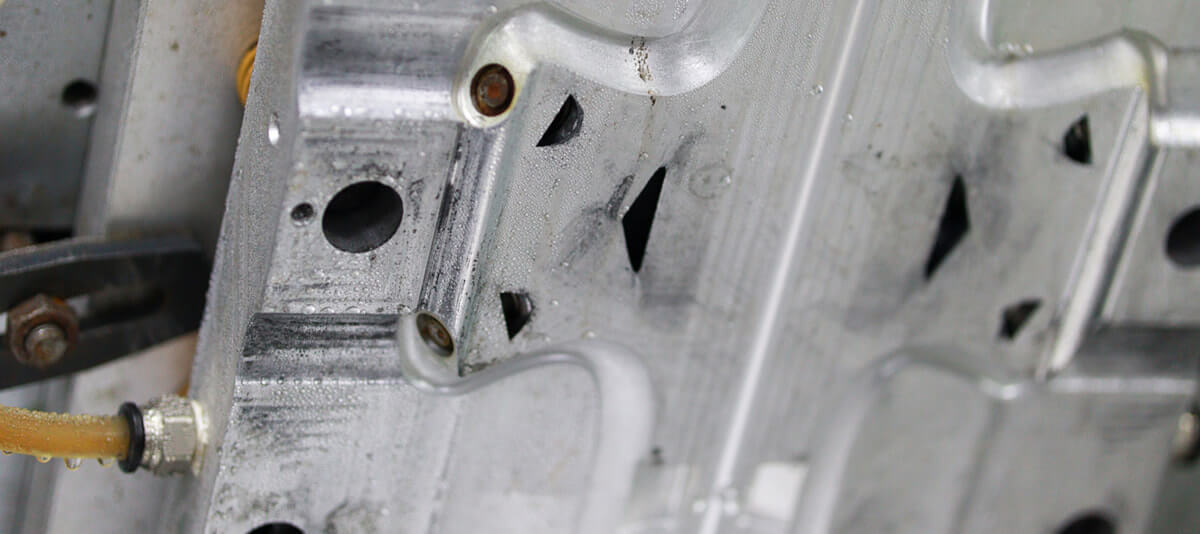
Injection molding is fundamentally a heat transfer process.
Molten plastic enters the mold cavity at temperatures often ranging from:
- 180°C to 350°C
depending on the resin type. The mold then removes heat from the material until the part solidifies sufficiently for ejection.
The cooling phase typically accounts for:
- 60–80% of the total molding cycle time
But cooling is not only about speed. The way heat is removed from the plastic determines:
- Crystallization behavior
- Molecular orientation
- Internal stress distribution
- Surface replication quality
- Final dimensional stability
This means mold temperature directly affects both cosmetic appearance and structural performance.
The Physics Behind Mold Temperature Control
Heat transfer inside the mold follows basic thermal conduction principles:
Q=kA(ΔT/L)
Where:
- (Q) = heat transfer rate
- (k) = thermal conductivity
- (A) = heat transfer area
- (ΔT) = temperature difference
- (L) = thermal path length
In practical molding applications, this means:
- Larger temperature differences increase cooling speed
- Poor thermal conductivity slows heat removal
- Uneven mold temperature creates uneven shrinkage
The challenge is not simply removing heat quickly, but removing it uniformly and predictably.
Mold Temperature Directly Affects Shrinkage
All thermoplastics shrink during cooling.
However, shrinkage is rarely uniform. Different cooling rates in different mold areas create uneven internal stress and dimensional variation.
If one side of the mold cools faster than the other, the result may include:
- Warpage
- Bending
- Twisting
- Ovality
- Dimensional instability
This becomes especially critical for:
- Automotive parts
- Precision housings
- Electronic connectors
- Medical components
Even small mold temperature differences may create measurable dimensional deviation.
Low Mold Temperature: Faster Cycles but Higher Risk
Many factories intentionally lower mold temperature to reduce cycle time and increase output.
While lower mold temperature improves cooling speed, excessive cooling creates several quality risks.
Common Problems Caused by Low Mold Temperature
Poor Surface Finish
If the melt freezes too quickly near the cavity surface, the material cannot fully replicate mold texture or gloss.
This may cause:
- Flow marks
- Weld lines
- Matte surfaces
- Poor gloss consistency
This issue is especially visible in high-gloss consumer products.
Increased Internal Stress
Rapid cooling locks molecular orientation into the plastic structure before stress can relax naturally.
This increases:
- Residual stress
- Cracking risk
- Stress whitening
- Long-term deformation
Transparent plastics such as PC and PMMA are particularly sensitive.
Short Shots and Filling Problems
Low mold temperatures increase melt viscosity during cavity filling.
This may lead to:
- Incomplete filling
- Thin-wall defects
- Weak weld lines
- Reduced bonding strength
High-flow engineering plastics often require relatively high mold temperatures to fill complex geometries properly.
High Mold Temperature: Better Quality but Longer Cycles
Higher mold temperatures generally improve part quality, but they also increase cycle time.
This creates a balance between productivity and product performance.
Advantages of Higher Mold Temperature
Better Surface Replication
Higher mold temperatures allow the melt to remain fluid longer, improving cavity replication.
This improves:
- Surface gloss
- Texture detail
- Optical clarity
- Weld line appearance
For optical lenses and piano-black automotive interiors, precise mold temperature control is essential.
Reduced Internal Stress
Slower cooling allows polymer chains to relax more uniformly.
This reduces:
- Residual stress
- Cracking tendency
- Long-term deformation
Improved Mechanical Strength
For semi-crystalline materials such as:
- PA
- PBT
- PET
- PPS
higher mold temperature improves crystallization quality.
This enhances:
- Tensile strength
- Chemical resistance
- Heat resistance
- Dimensional stability
Different Plastics Require Different Mold Temperatures
Each resin family has different thermal behavior.
Typical mold temperature ranges include:
| Material | Typical Mold Temperature |
|---|---|
| PP | 20–50°C |
| ABS | 40–80°C |
| PC | 80–120°C |
| PA | 70–120°C |
| PET | 120–160°C |
| PMMA | 60–90°C |
Semi-crystalline plastics usually require higher mold temperatures than amorphous plastics because crystallization must occur under controlled thermal conditions.
Mold Temperature and Crystallization
Crystallization behavior is one of the most technically important aspects of mold temperature control.
Semi-crystalline polymers form ordered molecular structures during cooling.
If cooling is too rapid:
- Crystallization becomes incomplete
- Mechanical properties decrease
- Dimensional instability increases
Higher mold temperatures allow more complete crystal growth.
This improves:
- Structural stability
- Chemical resistance
- Thermal resistance
- Long-term durability
However, excessive mold temperature may also increase shrinkage and cycle time.
This is why optimizing mold temperature requires balancing both quality and productivity.
Uneven Mold Temperature Is Often Worse Than Incorrect Temperature
One of the biggest misconceptions in injection molding is focusing only on average mold temperature.
In reality, temperature uniformity is often more important.
A mold operating uniformly at:
- 70°C
may produce better results than one fluctuating between:
- 55–75°C
Uneven mold temperature creates:
- Differential shrinkage
- Uneven crystallization
- Variable surface appearance
- Part deformation
Complex molds with deep ribs, thick sections, or multi-cavity layouts are especially vulnerable.
Cooling Channel Design Matters
Mold temperature stability depends heavily on cooling channel design.
Poor cooling layouts create thermal dead zones where heat accumulates continuously.
Common cooling design problems include:
- Cooling channels too far from cavity surfaces
- Uneven channel spacing
- Poor flow balance
- Low coolant turbulence
- Dead-end flow circuits
Modern molds increasingly use:
- Conformal cooling channels
- Baffle cooling
- Bubblers
- Spiral cooling circuits
to improve thermal uniformity.
Why Water Flow Rate Is Critical
Many factories focus only on coolant temperature while ignoring flow rate.
In reality, insufficient flow dramatically reduces heat transfer efficiency.
Turbulent flow is usually required for effective mold cooling.
The Reynolds number determines whether coolant flow becomes turbulent:
Re=(ρvD)/μ
Higher turbulence improves:
- Heat transfer coefficient
- Temperature uniformity
- Cooling response speed
Low flow velocity may create laminar flow, reducing cooling efficiency significantly.
Mold Temperature Controllers vs Chillers
This is another commonly misunderstood topic.
Chillers
Industrial chillers primarily provide:
- Heat removal
- Stable coolant supply
- Centralized cooling
Typical operating range:
- 5–30°C water supply
Best suited for:
- General cooling
- Hydraulic cooling
- Standard mold cooling
Mold Temperature Controllers (MTC)
MTC systems actively heat and cool molds using:
- Water
- Pressurized water
- Thermal oil
Temperature range may reach:
- 180°C+
- or even 300°C for oil systems
MTC systems are commonly used for:
- Engineering plastics
- Optical parts
- Thin-wall molding
- High-gloss surfaces
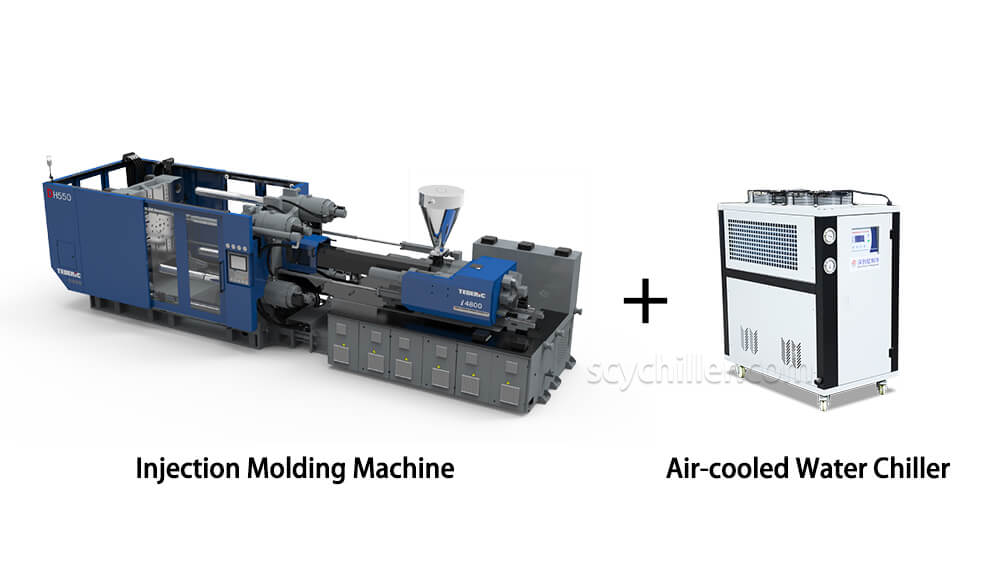
In many factories, chillers and mold temperature controllers work together.
Precision Mold Temperature Control in Advanced Manufacturing
Modern industries increasingly require extremely stable mold temperatures.
Typical precision requirements include:
| Application | Temperature Stability |
|---|---|
| General consumer products | ±1°C |
| Automotive components | ±0.5°C |
| Optical/medical parts | ±0.1–0.3°C |
Achieving this level of precision requires:
- Stable chiller systems
- Proper pump sizing
- Balanced cooling circuits
- Intelligent temperature control
- Real-time monitoring
Energy Efficiency vs Product Quality
Factories often face a tradeoff between:
- Faster cycles
- Lower energy consumption
- Better product quality
Lower mold temperatures reduce cycle time but may increase defects.
Higher mold temperatures improve quality but consume more energy and reduce productivity.
The optimal process depends on:
- Resin type
- Part geometry
- Cosmetic requirements
- Mechanical performance targets
The best manufacturers optimize the entire thermal process rather than simply maximizing cooling speed.
Conclusion
Mold temperature directly affects nearly every aspect of injection molded product quality, including surface appearance, dimensional stability, crystallization behavior, mechanical performance, and long-term reliability.
The goal of mold cooling is not simply removing heat as quickly as possible, but controlling heat transfer uniformly and predictably throughout the molding cycle.
Proper mold temperature management requires balancing:
- Cooling speed
- Temperature uniformity
- Material behavior
- Energy efficiency
- Product performance
As injection molding technology continues advancing, precision thermal control will become increasingly important for achieving both high productivity and consistent product quality.
