
Choosing between a scroll chiller and a screw chiller is one of those decisions that can make or break an industrial cooling project. At first glance, both systems use the same basic vapor-compression refrigeration technology — but under the hood, they’re fundamentally different machines with different strengths, weaknesses, and ideal use cases.

Here’s the thing most people miss: when engineers compare these chillers, they’re not really comparing “two chillers.” They’re choosing between two completely different refrigeration philosophies. The compressor architecture determines how the system behaves under part load, how efficiently it runs during continuous duty, how stable the cooling output stays, and how well it can handle future expansion.

Bottom line: Pick the wrong compressor type for your application, and you’ll pay for it in energy bills, maintenance headaches, or production downtime for years to come.

What Is a Scroll Chiller?

물 냉각 스크롤 물 냉각기 2
수냉식 스크롤 워터 냉각기

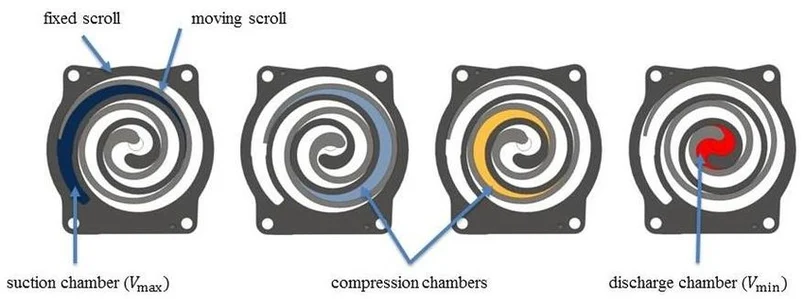
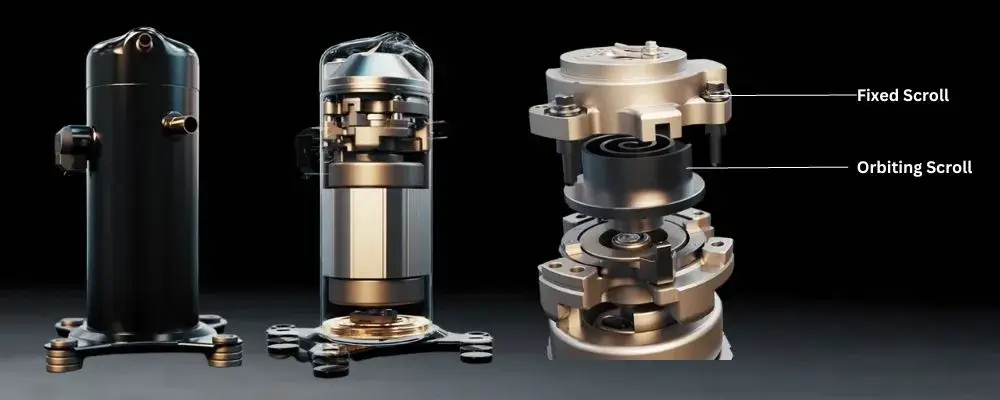
A scroll chiller uses one or more scroll compressors as its refrigeration core. Inside the compressor are two spiral-shaped scroll elements — one fixed, one orbiting. As the orbiting scroll moves, refrigerant gets trapped in progressively smaller pockets, compressing the gas smoothly toward the center discharge port.

Unlike piston compressors, scroll compressors have very few moving parts and no suction or discharge valves. This creates a smooth, quiet compression process with low vibration and minimal mechanical wear.

Scroll chillers are the go-to choice for:

  • Small to medium industrial cooling systems
  • Laboratory cooling
  • Laser equipment
  • Plastic processing
  • Medical equipment
  • 상업용 HVAC
  • Modular air-cooled chillers

What Is a Screw Chiller?

산업용 수냉식 스크류 냉각기(이중 압축기)2

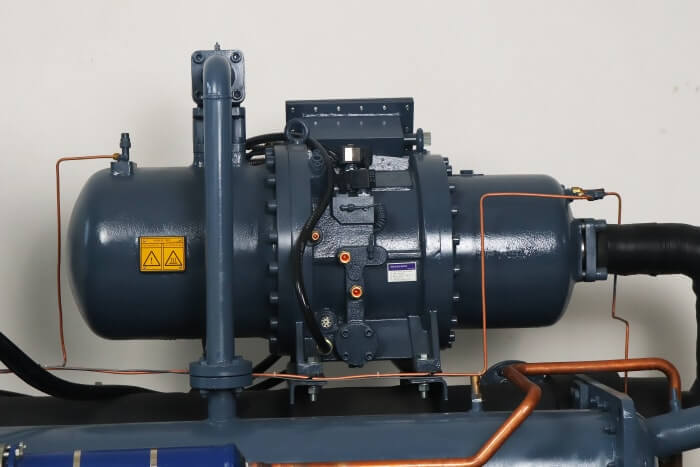
A screw chiller uses a rotary screw compressor that compresses refrigerant through two intermeshing helical rotors. These rotors continuously trap and compress refrigerant as it moves along the rotor length, handling much larger refrigerant flow volumes than scroll compressors.

Screw chillers are built for the heavy lifting:

  • Large refrigerant flow volume
  • High cooling loads
  • Continuous-duty operation
  • Stable industrial performance

You’ll find screw chillers dominating applications like:

  • Chemical processing
  • Pharmaceutical plants
  • Battery manufacturing
  • Large injection molding facilities
  • Food processing
  • Data centers
  • Centralized industrial cooling systems

The Fundamental Mechanical Difference

The core difference between these technologies comes down to how refrigerant compression actually happens.

스크롤 압축기는 어떻게 작동합니까?

스크롤 압축기 uses orbital motion in small, enclosed chambers. The process is smooth, compact, and mechanically simple — think of it as squeezing the refrigerant through a gradually tightening spiral.

스크류 압축기 uses rotating helical rotors that compress refrigerant continuously with much larger throughput capacity — more like pushing refrigerant through a constantly narrowing tunnel.

This mechanical distinction drives major differences in:

  • Capacity range
  • Efficiency curve
  • Oil management
  • Noise behavior
  • Heat load response
  • Long-term durability

Capacity Range: Where Each Technology Makes Sense

One of the clearest differences is cooling capacity. Here’s where each technology hits its sweet spot:

TechnologyTypical RangeSweet Spot
스크롤 냉각기Up to ~150 RT (sometimes 200 RT in modular setups)Small to medium systems, modular configurations
스크류 냉각기80 RT to 600+ RT (large systems can exceed 1000 RT)Medium to large industrial loads, continuous operation

Beyond about 150 RT, the number of scroll compressors required becomes inefficient and mechanically complex. That’s where screw compressors take over — they handle larger refrigerant mass flow rates far more efficiently than stacking multiple small scroll compressors.

Practical tip: In large industrial plants, screw chillers usually provide lower lifecycle cost despite higher initial investment. But for smaller loads, scroll systems are hard to beat on simplicity and upfront cost.

Part-Load Efficiency: The Real-World Factor

Here’s something most catalog specs won’t tell you: industrial chillers rarely run at 100% load continuously. Real systems deal with seasonal variation, production fluctuation, startup/shutdown cycles, and variable process demand. This is where part-load efficiency becomes critical.

Scroll Chiller Part-Load Behavior

Scroll chillers typically use multiple independent compressors staged together — think 4-scroll, 6-scroll, or 8-scroll modular systems. As cooling demand changes, compressors switch on or off incrementally.

This gives scroll chillers excellent part-load efficiency in smaller systems because inactive compressors consume zero power. At light load conditions, they can be surprisingly efficient.

Screw Chiller Part-Load Behavior

Screw compressors regulate capacity differently. Instead of cycling compressors on and off, they use slide valve control or variable frequency drives (VFD) for stepless capacity modulation. This allows smooth, continuous adjustment across wide load ranges.

At medium and high loads, screw chillers usually outperform scroll systems because the compressor maintains stable compression efficiency without the repeated cycling that wastes energy and stresses components.

Energy Efficiency: It Depends on Your Operating Profile

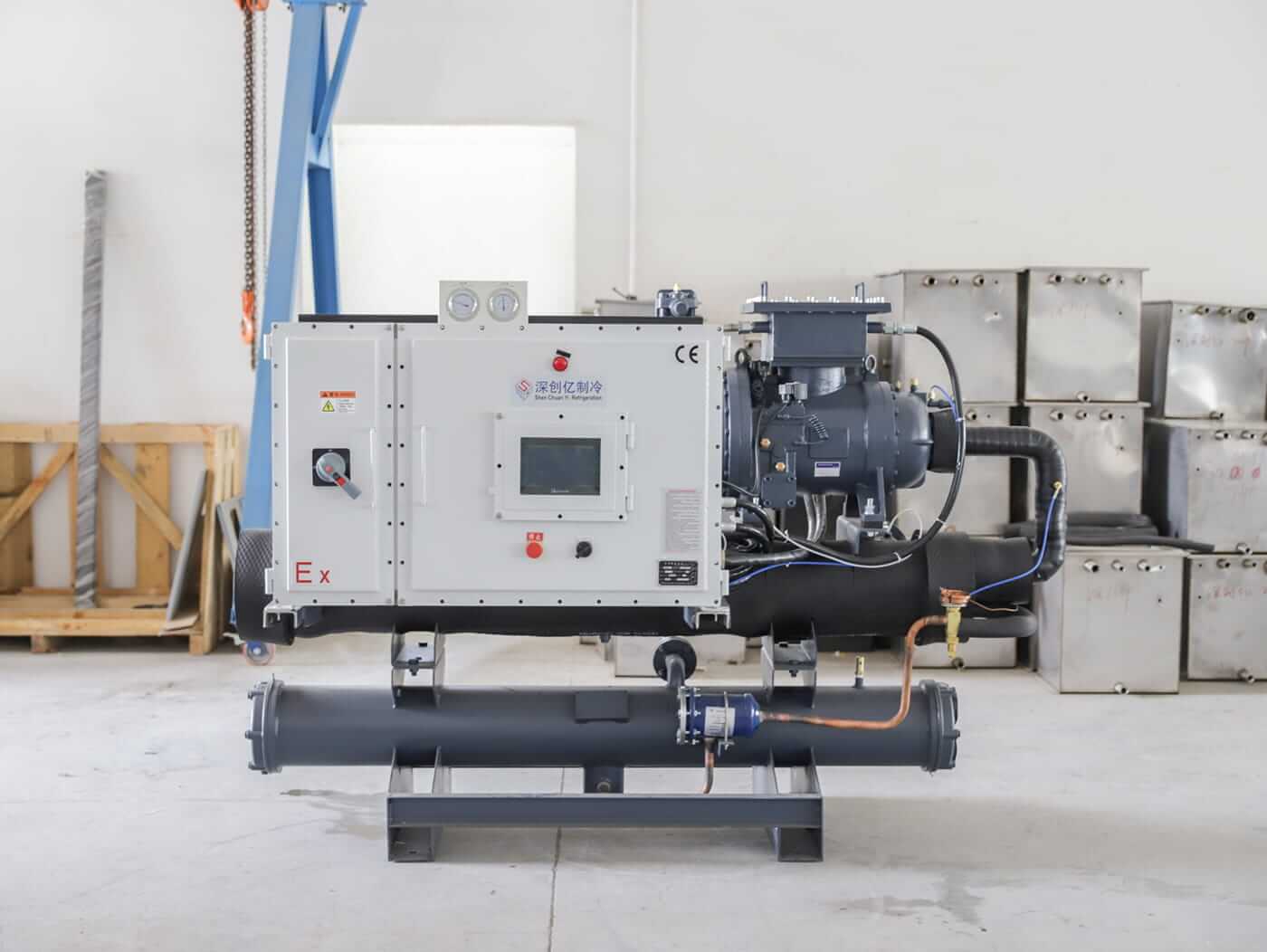
수냉식 방폭 냉각기
수냉식 방폭 냉각기

There’s no universally “better” technology here — efficiency depends entirely on how you operate.

Scroll Chillers Shine When:

  • Cooling loads are relatively small
  • Load fluctuates frequently
  • Runtime is intermittent rather than continuous
  • Installation simplicity matters
  • Ambient conditions are moderate

The simplified mechanical structure reduces internal losses, and fewer moving parts help maintain efficiency at smaller capacities.

Screw Chillers Become Superior When:

  • Cooling loads are large
  • Systems operate 24/7
  • Process heat load is stable
  • Continuous-duty operation is required
  • Centralized cooling systems are used

At high refrigeration tonnage, screw compressors generally deliver better full-load efficiency and lower long-term operating cost. Water-cooled screw chillers especially achieve very high efficiency because they maintain lower condensing temperatures.

Oil Management: The Hidden Difference

냉각유 유동점

Oil behavior is one of the most overlooked differences between these technologies, but it matters a lot for long-term reliability.

스크롤 압축기

3. 스크롤 압축기의 advantages

Scroll compressors contain relatively small oil volumes, and oil circulation is simpler because refrigerant mass flow is smaller. Maintenance requirements are generally lower.

However, they’re more sensitive to:

  • Liquid refrigerant floodback
  • Oil starvation
  • Improper refrigerant charging

Because the system is compact, improper operating conditions can damage the compressor relatively quickly.

나사 압축기

스크류 압축기

Screw compressors rely heavily on oil for rotor sealing, lubrication, and cooling. This creates a more sophisticated oil management system with oil separators, filters, return systems, and cooling circuits.

While more complex, this design allows screw compressors to operate continuously under heavy industrial loads. Proper oil management is critical for long-term reliability — neglect it, and you’ll have problems. Maintain it properly, and these compressors can run for decades.

Noise and Vibration Considerations

Scroll chillers are generally quieter because scroll compression is smooth and continuous with minimal pulsation. This makes them ideal for:

  • 병원
  • 실험실
  • Office environments
  • Indoor installations near occupied spaces

Screw chillers generate more mechanical noise because of rotor meshing and larger refrigerant throughput. However, industrial screw chillers usually compensate with acoustic insulation, vibration isolation, and machinery room installation. In large factories, the noise difference is usually less important than cooling stability and capacity.

Maintenance and Reliability Trade-offs

스크롤 냉각기

  • Fewer moving parts
  • Simpler structure
  • Easier servicing
  • Lower initial repair cost

스크류 냉각기

  • Built for industrial rebuildability
  • Long service life
  • Rotor inspection possible
  • Bearing replacement options

Scroll chillers are often viewed as “low-maintenance” systems, and that’s fair — when a scroll compressor fails, replacement is usually more practical than internal rebuilding. It’s a swap-and-go approach.

Screw compressors, by contrast, are designed for the long haul. Major industrial screw chillers are built for rotor inspection, bearing replacement, and tens of thousands of operating hours. In large factories running continuously, screw chillers usually provide superior long-term durability.

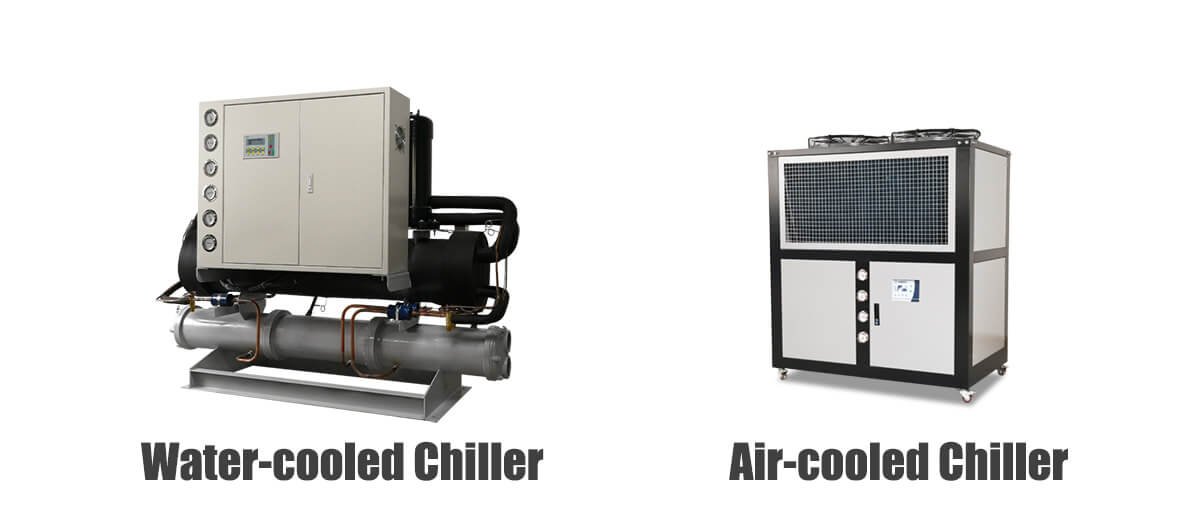
Air-Cooled vs Water-Cooled Integration

수냉식 냉각기 대 공냉식 냉각기

Both scroll and screw chillers can be air-cooled or water-cooled, but industry tendencies differ:

ConfigurationTypical UseWhy It Works
Air-Cooled ScrollSmall to medium systems, decentralized coolingSimpler installation, lower infrastructure cost, capacity matches air-cooling efficiency
Water-Cooled ScrewLarge industrial plants, centralized systemsBetter efficiency at high loads, stable condensing temperature, matches existing utility infrastructure

Most scroll systems are air-cooled because the capacity is smaller and installation simplicity matters. Large screw chillers frequently use water-cooled condensers because water cooling improves efficiency, especially at high loads, and large plants usually already have cooling tower infrastructure.

Industry-Specific Recommendations

Scroll Chillers Are Usually Better For:

  • Laser cooling
  • Small injection molding workshops
  • 실험실
  • Medical equipment
  • Small food processing lines
  • Modular HVAC systems

Screw Chillers Are Usually Better For:

  • Chemical plants
  • Pharmaceutical production
  • Battery factories
  • Large plastics manufacturing
  • Fermentation facilities
  • Continuous industrial processes
  • Centralized cooling plants

Cost Comparison: Upfront vs Lifecycle

Initial cost and lifecycle cost are very different things, and this is where many projects go wrong.

Cost Factor스크롤 냉각기스크류 냉각기
Purchase price낮추다더 높은
Installation costLower (especially air-cooled)Higher (especially water-cooled)
Maintenance complexity낮추다더 높은
Energy efficiency (large loads)좋은더 나은
Industrial lifespan좋은Longer
ROI (continuous operation)Fair더 나은

For small facilities with intermittent operation, scroll chillers are often more economical. For large 24/7 industrial plants, screw chillers frequently become cheaper over the long term despite higher purchase cost — the energy savings and durability advantages add up over years of continuous operation.

The Most Important Selection Principle

Here’s the question that should drive your decision:

How does the cooling load behave over time?

If your system experiences:

  • Small load
  • Frequent cycling
  • Intermittent runtime

Scroll technology is usually more practical.

If your system requires:

  • Large capacity
  • 연속운전
  • Stable process cooling
  • Long-term scalability

스크류 냉각기 are usually the better engineering solution.

결론

Scroll and screw chillers aren’t competitors — they’re tools designed for fundamentally different jobs. Scroll chillers excel in smaller, modular, lower-maintenance applications where part-load efficiency and installation simplicity matter most. Screw chillers dominate larger industrial systems where continuous-duty operation, stable thermal control, and high refrigeration capacity are non-negotiable.

Neither technology is universally better. The optimal choice depends on your specific situation: cooling load size, operating profile, energy strategy, process stability requirements, and long-term operating economics.

Understanding these differences allows you to select a chiller system that matches the real thermal behavior of your application — rather than simply choosing based on nominal capacity or upfront price alone.

답글 남기기

이메일 주소는 공개되지 않습니다. 필수 필드는 *로 표시됩니다